
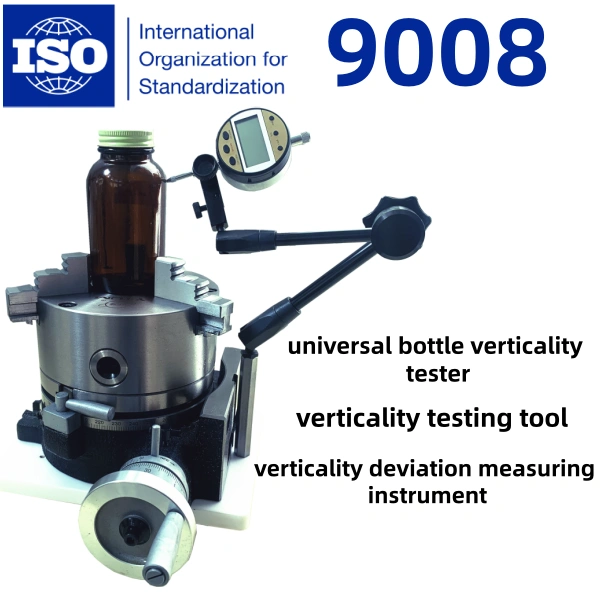
The ISO 9008 Perpendicularity Tester is a precision testing instrument designed to measure the vertical alignment and perpendicularity deviation of bottle containers. In industries where container appearance, filling performance, sealing reliability, and production consistency are critical, accurate bottle verticality measurement helps manufacturers maintain quality standards and prevent defects caused by tilted or misaligned containers.
A bottle that does not stand vertically may create problems during filling, labeling, capping, transportation, and automated packaging processes. To evaluate these dimensional characteristics, manufacturers use a universal bottle verticality tester to determine the deviation between the bottle axis and the ideal vertical reference line.
The bottle perpendicularity tester for verticality testing is widely applied in food packaging, beverage containers, cosmetic bottles, pharmaceutical packaging, and laboratory quality control. By providing precise measurement data, this type of verticality testing tool helps engineers identify manufacturing variations and optimize production processes.
The PER-01 Perpendicularity Tester from Cell Instruments is developed for accurate bottle alignment inspection. It applies a rotational measurement method to evaluate bottle vertical axis deviation and supports quality control requirements related to ISO 9008, GB 8452, QB 2357, QB/T 1868, and YBB 00192003.
What Is a Bottle Perpendicularity Tester?
A bottle perpendicularity tester is a specialized instrument used to measure how much a bottle deviates from its ideal vertical axis. It evaluates the relationship between the bottle body, bottle mouth, and central axis to determine whether the container maintains proper vertical alignment.
During manufacturing, bottles may experience dimensional changes due to:
- Mold precision variations
- Uneven cooling during forming
- Material shrinkage
- Mechanical processing errors
- Improper handling after production
Even small deviations can affect downstream operations. For example, an inclined bottle neck may cause:
- Incorrect cap installation
- Poor sealing performance
- Label positioning errors
- Instability on conveyor systems
- Reduced visual quality of finished products
A verticality deviation measuring instrument provides quantitative data instead of relying on visual inspection. This allows quality engineers to make objective decisions based on measured values.
Why Is Bottle Verticality Measurement Important?
Bottle manufacturers often focus on capacity, thickness, and strength testing, but vertical alignment is also an important quality parameter. A container must maintain dimensional accuracy to perform reliably throughout its service life.
Improving Production Quality
A precise verticality test helps manufacturers detect production problems at an early stage. When excessive deviation appears, engineers can adjust:
- Mold design
- Forming temperature
- Production parameters
- Machine alignment
This reduces waste and improves manufacturing efficiency.
Ensuring Packaging Line Compatibility
Modern packaging lines rely heavily on automated systems. Filling machines, capping machines, labeling equipment, and inspection systems require containers with consistent geometry.
A bottle with poor perpendicularity may cause:
- Positioning failures
- Machine stoppages
- Incorrect closure application
- Reduced production speed
Using a universal bottle verticality tester during incoming inspection and production monitoring helps ensure smooth operation.
Maintaining Product Appearance
For industries such as cosmetics and premium beverages, appearance directly influences customer perception. Bottles that lean or show inconsistent alignment may reduce product value.
Verticality testing supports manufacturers in achieving:
- Uniform bottle appearance
- Better shelf presentation
- Higher product consistency
Working Principle of ISO 9008 Perpendicularity Tester
The ISO 9008 Perpendicularity Tester uses a rotational measurement principle to determine bottle vertical axis deviation.
The bottle sample is fixed securely on a rotating platform. A measuring probe or dial gauge contacts the bottle mouth area. When the bottle rotates 360 degrees, the instrument records the highest and lowest measurement values.
The verticality deviation is calculated according to the difference between these two readings:
Vertical axis deviation = (Maximum reading – Minimum reading) / 2
This calculation reflects the amount of deviation between the actual bottle axis and the reference vertical axis.
The measurement process provides repeatable and reliable results because:
- The sample rotates consistently
- The measuring position remains stable
- The probe detects dimensional changes accurately
- The operator can obtain numerical results instead of subjective judgment
How to Perform a Bottle Verticality Test?
A typical bottle perpendicularity test includes the following steps:
1. Prepare the Bottle Sample
Before testing, ensure the sample is clean and free from external contamination. Select bottles according to the required inspection criteria.
2. Install the Sample
Place the bottle on the rotating plate and secure it properly. The bottle position should remain stable throughout the test.
3. Adjust the Measuring Probe
Move the probe until it contacts the specified measurement point, usually the bottle mouth area.
The fine adjustment function allows operators to position the probe accurately.
4. Rotate the Bottle
Rotate the bottle through a complete 360-degree cycle. During rotation, the dial gauge records changes caused by bottle deviation.
5. Record and Analyze Results
Record the maximum and minimum values, then calculate the vertical axis deviation.
The final result can be compared with internal quality requirements or applicable standards such as ISO 9008.
Key Features of PER-01 Universal Bottle Verticality Tester
The PER-01 is designed as a practical verticality testing tool for laboratories, manufacturers, and quality inspection departments.
High Measurement Resolution
The instrument supports measurement resolution down to 0.001 mm, allowing engineers to detect very small dimensional differences.
This high precision is valuable for:
- Pharmaceutical containers
- Small precision bottles
- Cosmetic packaging
- Research and development testing
Stable Sample Rotation System
A controlled rotation mechanism ensures that the bottle moves smoothly during measurement. Stable rotation improves repeatability and reduces operator influence.
Flexible Probe Adjustment
The adjustable measuring probe allows users to adapt the instrument for different bottle structures and testing requirements.
Wide Sample Compatibility
The tester can accommodate different bottle sizes:
| Parameter | Specification |
|---|---|
| Sample Diameter | 5 mm–145 mm (customizable) |
| Test Range | 0–12.7 mm (customizable) |
| Division Value | 0.01 mm or 0.001 mm optional |
| Measurable Height | 15 mm–300 mm (customizable) |
This flexibility makes it suitable for various container types.
Data Management Capability
Optional PC Excel data export improves laboratory management by allowing users to:
- Store measurement records
- Create inspection reports
- Analyze quality trends
- Maintain traceability documentation
Applications of Bottle Verticality Testing
A bottle perpendicularity tester is used across multiple industries where container geometry affects product performance.
Beverage Packaging
Glass bottles and plastic beverage containers require accurate alignment for:
- Filling operations
- Capping processes
- Label placement
- Automated handling
Verticality testing helps beverage manufacturers maintain consistent container quality.
Food Packaging
Food containers must meet appearance and functional requirements. Verticality inspection supports quality assurance for jars, bottles, and specialty containers.
Cosmetic Packaging
Cosmetic packaging often requires high visual standards. Small deviations in bottle shape can influence product appearance and brand image.
Pharmaceutical Packaging
Pharmaceutical containers require strict quality control because packaging performance affects product safety and usability.
Applications include:
- Vials
- Small bottles
- Medical containers
Bottle Manufacturing
Bottle producers use verticality testing during:
- Incoming material inspection
- Production process monitoring
- Final quality inspection
Materials Suitable for Verticality Deviation Measurement
The ISO 9008 Perpendicularity Tester can evaluate containers made from various materials, including:
| Material | Typical Applications |
|---|---|
| Glass | Pharmaceutical bottles, beverage bottles |
| PET | Plastic beverage containers |
| HDPE | Chemical and pharmaceutical containers |
| PP | Laboratory and cosmetic packaging |
| Other molded plastics | Specialty containers |
Different materials may experience different forming behaviors, making dimensional inspection important for maintaining production consistency.
Related Standards for Bottle Perpendicularity Testing
Bottle verticality measurement may follow industry standards and customer-specific requirements. Relevant standards include:
| Standard | Application |
|---|---|
| ISO 9008 | Glass container dimensional requirements related to verticality measurement |
| GB 8452 | Glass bottle testing requirements |
| QB 2357 | Bottle-related quality requirements |
| QB/T 1868 | Packaging container testing |
| YBB 00192003 | Pharmaceutical packaging material requirements |
Standards help manufacturers establish consistent testing methods and acceptance criteria.
Choosing the Right Verticality Testing Equipment
When selecting a verticality deviation measuring instrument, engineers should consider:
Measurement Accuracy
The instrument should provide sufficient resolution according to the container type and quality requirements.
Sample Size Range
Different industries use different bottle sizes. A suitable tester should support the required diameter and height range.
Repeatability
A reliable instrument should minimize operator influence and provide consistent results between measurements.
Data Management
For modern laboratories, digital recording and data export functions improve efficiency and traceability.
Customization Capability
Some applications require customized fixtures or special measurement solutions. Manufacturers with engineering capability can provide modified systems for unique testing needs.
Quality Control Benefits of Bottle Verticality Testing
Implementing a bottle verticality inspection process provides several advantages:
- Improves production consistency
- Reduces packaging defects
- Supports automated production compatibility
- Enhances customer confidence
- Provides measurable quality data
- Helps meet industry standards
For bottle manufacturers and end users, accurate verticality measurement is an important part of comprehensive packaging quality control.
Key Takeaways
The ISO 9008 Perpendicularity Tester provides an effective solution for evaluating bottle alignment and vertical axis deviation. Through precise rotational measurement, manufacturers can identify dimensional variations that may affect production efficiency, packaging performance, and product appearance.
As a professional bottle perpendicularity tester for verticality testing, the PER-01 supports laboratories and production facilities in food, beverage, cosmetic, and pharmaceutical industries. With high-resolution measurement, flexible sample compatibility, and reliable operation, this verticality testing tool helps companies achieve better quality control and maintain consistent container performance.