
Overview of Carbonation Tester for Beverages
A Carbonation Tester for Beverages is used to determine the dissolved carbon dioxide (CO₂) level in carbonated beverages by measuring pressure and temperature and correlating the results with established carbonation tables. Accurate carbonation measurement is important for beverage manufacturers because CO₂ concentration directly influences product consistency, mouthfeel, freshness, foaming behavior, and consumer perception. For laboratories and production facilities working with carbonated soft drinks, sparkling water, beer, and other beverages, choosing the appropriate testing method can significantly affect testing efficiency and repeatability.
Cell Instruments offers two different solutions for this application: the CLRT-01 Carbonation Tester for Beverages și CLRT-02 Manual Carbonation Tester for Beverages. Both instruments are designed for beverage carbonation testing and support applications related to ASTM F1115 și GB/T 10792, but their operating principles and levels of automation are different.
The CLRT-01 focuses on automated and repeatable carbonation measurement, while the CLRT-02 provides a manual and cost-effective testing solution. Understanding these differences helps laboratories, beverage manufacturers, and purchasing managers select the appropriate carbonation testing equipment.
What Does a Carbonation Tester for Beverages Measure?
Carbonated beverages contain CO₂ dissolved in the liquid under pressure. The amount of dissolved CO₂ changes with temperature and pressure, so carbonation measurement requires both parameters to be considered.
A Carbonation Tester for Beverages typically measures:
- Internal pressure
- Beverage temperature
- Carbonation level or CO₂ volume
The measured pressure and temperature values can then be correlated with an appropriate carbonation table to determine the beverage’s CO₂ volume.
For example, two beverage samples may produce different pressure readings even when they contain similar amounts of dissolved CO₂ if their temperatures are different. Therefore, temperature control or accurate temperature measurement is an important part of reliable carbonation testing.
This makes carbonation testing useful for:
- Finished-product quality control
- Production batch comparison
- Beverage formulation development
- Filling-process verification
- Carbonation process monitoring
- R&D testing
- Packaging and shelf-life studies
Why Is Carbonation Testing Important for Beverages?
Carbonation is an important quality characteristic for many beverages. Too little CO₂ may produce a flat or weak sensory profile, while excessive carbonation can affect foaming, filling behavior, package pressure, and consumer experience.
Routine carbonation testing allows manufacturers to establish measurable quality limits instead of relying only on sensory evaluation.
Typical applications include:
| Beverage Type | Purpose of Carbonation Testing |
|---|---|
| Carbonated soft drinks | Verify target carbonation level |
| Soda | Monitor batch-to-batch consistency |
| Sparkling water | Confirm dissolved CO₂ content |
| Beer | Evaluate carbonation consistency |
| Craft beverages | Support product development and QC |
| Fermented beverages | Monitor carbonation characteristics |
| Energy drinks | Verify production specifications |
For laboratories, a standardized measurement method also provides a more objective basis for comparing samples.
CLRT-01 vs. CLRT-02 Carbonation Tester for Beverages
The main difference between the two carbonation testers is their level of automation. The CLRT-01 is designed for automatic carbonation testing, reducing manual intervention during the testing process. The CLRT-02 is a manual carbonation tester, requiring the operator to manually perform the testing steps.
- CLRT-01 – Automatic: Suitable for laboratories and production environments that prioritize automated operation, consistency, and testing efficiency.
- CLRT-02 – Manual: Suitable for routine laboratory testing where a simple, straightforward, and operator-controlled testing process is preferred.
In short, CLRT-01 focuses on automated testing, while CLRT-02 focuses on manual testing. Both use the same basic pressure-and-temperature principle for evaluating beverage carbonation.
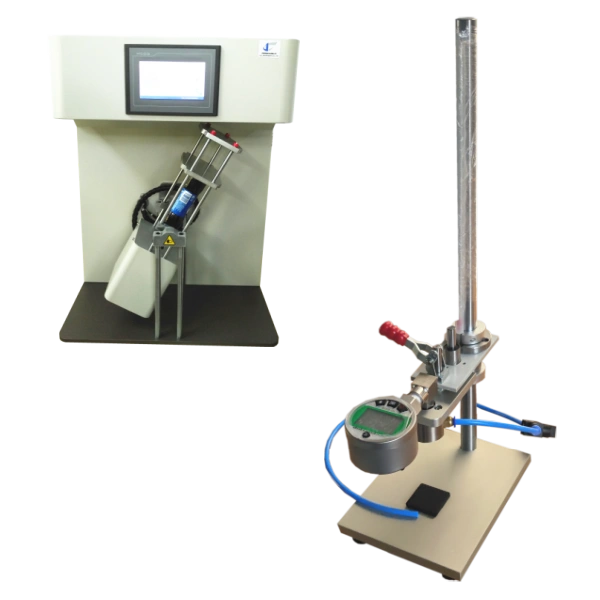
Testarea automatizată a carbonației cu CLRT-01
The CLRT-01 is designed for users who need a controlled and repeatable carbonation testing workflow.
Instead of requiring the operator to manually perform every step, the instrument uses a PLC-controlled system and servo motor to standardize the test sequence.
The typical workflow includes:
Automatic Piercing → Pressure Stabilization → Agitation → Pressure & Temperature Measurement → CO₂ Calculation
1. Automatic Cap Piercing
The CLRT-01 automatically penetrates the beverage container cap at a controlled speed. The default piercing speed is 5 mm/s, while other settings can be configured according to the application.
Automatic piercing helps reduce differences between operators and provides a more consistent starting condition for each test.
2. Pressure Stabilization
After piercing, the system uses the vent valve to release excess gas and establish a suitable measurement condition.
Stable pressure is important because an unstable reading can affect the final carbonation calculation.
3. Servo-Driven Agitation
The instrument uses a servo-driven mechanism to agitate the beverage sample. The default shaking time is 40 seconds, while the operating parameters can be customized.
Agitation helps redistribute dissolved CO₂ and promotes a more uniform condition before measurement.
This automated agitation is one of the major differences between the CLRT-01 and a manual soda Carbonation Tester for Beverages
4. Real-Time Measurement
The CLRT-01 records pressure and temperature during testing.
Its specifications include:
- Pressure range: 0–1 MPa
- Pressure resolution: 0.01 kPa
- Temperature range: 0–30°C
- Temperature resolution: 0.1°C
The measured values provide the basis for determining the carbonation level.
5. Automatic CO₂ Volume Calculation
After pressure and temperature measurements are obtained, the CLRT-01 can automatically calculate and display the corresponding CO₂ volume based on its embedded carbonation table.
This reduces manual calculation and helps simplify routine quality-control testing.
Manual Carbonation Testing with CLRT-02
The CLRT-02 Manual Carbonation Tester for Beveragesuses the same basic pressure-temperature concept but places the operator in control of the testing process.
This makes it suitable for laboratories that do not require automated agitation and data processing.
The basic manual procedure consists of six steps:
- Pierce – Manually penetrate the bottle cap using the quenching piercing head.
- Release Pressure – Open the vent valve to release excess gas.
- Stabilize – Close the valve and allow the pressure to stabilize.
- Agitate – Shake the beverage manually for approximately 40 seconds.
- Measure – Record the stabilized pressure and beverage temperature.
- Calculate – Compare the pressure-temperature readings with the carbonation volume table.
The CLRT-02 uses a 0–1 MPa pressure gauge with 0.0001 MPa resolution and supports pressure units such as MPa, psi, and bar.
Its manual operating method makes the instrument particularly practical for R&D laboratories, QA laboratories, and smaller testing volumes where automation is not essential.
ASTM F1115 for Beverage Carbonation Testing
ASTM F1115 – Standard Test Method for Determining the CO₂ Loss of Beverage Containers is an important reference for carbonation-related testing of beverage containers.
When selecting a Carbonation Tester for Beverages for ASTM F1115-related applications, laboratories should consider not only the instrument’s pressure range but also the complete testing procedure, sample configuration, temperature conditions, pressure stabilization, and data interpretation.
Both CLRT-01 and CLRT-02 are designed to support carbonation testing applications associated with ASTM F1115.
The instruments can also be applied with GB/T 10792, the Chinese standard for carbonated beverages.
| Standard | Main Application |
|---|---|
| ASTM F1115 | Determination of CO₂ loss of beverage containers |
| GB/T 10792 | Carbonated beverage testing |
The applicable edition and detailed test requirements should always be verified by the laboratory before conducting compliance testing.
Carbonation Testing in Beverages: What Affects the Result?
A reliable carbonation test depends on more than simply reading a pressure gauge. Several factors can influence the measured result.
Beverage Temperature
Temperature has a direct relationship with CO₂ solubility and pressure. Therefore, temperature should be measured accurately and considered when interpreting carbonation results.
The CLRT-01 provides real-time temperature monitoring with a 0.1°C resolution, helping operators monitor the sample condition during the test.
Agitation
Carbonated beverages may not have a completely uniform CO₂ distribution immediately after sampling. Agitation helps establish a more consistent condition before the final measurement.
The CLRT-01 uses controlled servo agitation, while the CLRT-02 relies on manual shaking.
Pressure Stabilization
Pressure should reach a stable condition before the final reading is recorded. Excessive pressure fluctuation can reduce measurement consistency.
The controlled pressure-release workflow of the CLRT-01 helps standardize this part of the procedure.
Operator Technique
Manual testing introduces additional variables, including:
- Piercing position
- Shaking intensity
- Shaking duration
- Pressure stabilization judgment
- Reading and recording technique
The CLRT-02 is still suitable for routine laboratory work, but operators should follow a consistent procedure.
Which Carbonation Tester for Beverages Is Better for Your Laboratory?
Neither instrument is universally better. The appropriate choice depends on testing volume, workflow, operator requirements, and budget.
Choose CLRT-01 If You Need:
- Automated carbonation testing
- Improved test-to-test repeatability
- Perforare automată a capacului
- Agitație controlată
- Real-time pressure and temperature acquisition
- Automatic CO₂ calculation
- PLC and touchscreen control
- Optional RS232 communication
- Optional printing
- Higher testing efficiency
The CLRT-01 is particularly suitable for beverage factories, centralized QA laboratories, R&D centers, and applications where multiple samples need to be tested under consistent operating conditions.
Choose CLRT-02 If You Need:
- Manual carbonation measurement
- A straightforward laboratory workflow
- Lower system complexity
- Direct operator control
- A practical solution for smaller testing volumes
- Flexible R&D testing
- Manual pressure-temperature evaluation
The CLRT-02 can be a good choice when the laboratory already has an established manual procedure and does not require automated agitation or automatic result processing.
Carbonation Tester for Beverage Applications in Beverage Quality Control
Carbonation measurement can support several stages of beverage production.
Incoming and process quality control:
Manufacturers can establish carbonation specifications and monitor samples during production.
Finished-product inspection:
Testing can verify whether finished beverages meet internal carbonation requirements before shipment.
R&D and formulation:
Product developers can compare different carbonation conditions during beverage development.
Batch comparison:
Testing provides numerical data for comparing production batches and identifying abnormal variation.
Packaging studies:
Carbonation-related measurements can also provide useful information when evaluating beverage containers and CO₂ retention.
These applications make a Carbonation Tester for Beveragesuseful not only as a single-purpose instrument but also as part of a broader beverage quality-control system.
Concluzie
A Carbonation Tester for Beverages measures beverage carbonation by evaluating internal pressure and temperature and relating the results to established CO₂ volume tables.CLRT-01 uses automated piercing, controlled agitation, real-time pressure and temperature measurement, and automatic CO₂ calculation. CLRT-02 provides a manual workflow using a precision pressure gauge, manual venting, shaking, and carbonation-table reference. Both instruments support beverage carbonation testing applications associated with ASTM F1115 and GB/T 10792.
Reliable carbonation measurement helps beverage manufacturers control product consistency, verify carbonation specifications, and support quality assurance throughout production. Instrumente celulare provides both automated and manual carbonation testing solutions for different laboratory and production requirements. The CLRT-01 is suited to users who prioritize automation, repeatability, and efficient routine testing, while the CLRT-02 provides a straightforward manual solution for R&D and QA applications. Contact Cell Instruments to discuss your beverage, container type, testing procedure, and applicable standard, and select the appropriate carbonation testing equipment for your application.