
Understanding Bottle Perpendicularity Testing and Its Importance
A perpendicularity tester is a precision measuring instrument designed to evaluate the vertical alignment and axis deviation of bottles and cylindrical containers. In industries such as beverage packaging, glass container manufacturing, cosmetics, and pharmaceutical packaging, maintaining accurate bottle verticality is essential for product appearance, filling performance, sealing reliability, and automated production compatibility.
During bottle production, dimensional variations, uneven material distribution, or molding deviations can cause the bottle body or neck axis to tilt. These deviations may affect labeling accuracy, capping performance, and stability during transportation. Therefore, manufacturers use a perpendicularity tester to perform accurate bottle verticality measurements and verify whether containers meet specified quality requirements.
Il glass bottle verticality test method evaluates the deviation between the bottle’s central axis and its vertical reference line. By measuring the maximum and minimum displacement during controlled rotation, engineers can determine the bottle’s vertical axis deviation and assess manufacturing consistency.
What Is a Perpendicularity Tester?
A perpendicularity tester, also known as a bottle deviation tester, coaxial tester, coaxiality tester, or circle runout tester, is a specialized device used to measure the perpendicularity or verticality deviation of bottle containers.
The instrument evaluates the relationship between:
- Bottle bottom reference plane
- Bottle vertical center axis
- Bottle neck or mouth position
A properly manufactured bottle should maintain a stable vertical axis when placed on a flat surface. Excessive deviation may result in:
- Bottle leaning during storage or display
- Difficulties in automatic filling and capping processes
- Incorrect positioning during labeling
- Reduced packaging appearance quality
Il beverage bottle eccentricity test for verticality is particularly important for beverage manufacturers because high-speed production lines require containers with consistent geometry and accurate positioning.
Testing Principle of Bottle Verticality Measurement
The perpendicularity test is based on a rotational measurement principle.
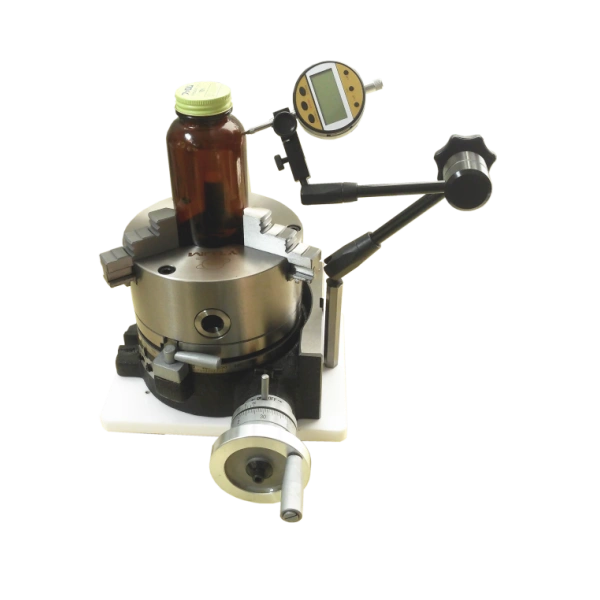
During testing, the bottle is fixed vertically on a rotating platform. A precision dial gauge contacts the bottle mouth or specified measuring point. When the bottle rotates 360°, the gauge detects the radial displacement caused by eccentricity or axis deviation.
The vertical axis deviation is calculated according to the difference between the maximum and minimum measured values:
Vertical axis deviation = (Maximum reading − Minimum reading) ÷ 2
This calculation provides a reliable measurement of bottle inclination and coaxial alignment.
The basic measurement process includes:
- Place the bottle securely on the rotating platform.
- Adjust the measuring probe until it contacts the bottle mouth.
- Rotate the bottle through a complete 360° cycle.
- Record the highest and lowest displacement values.
- Calculate the vertical deviation value.
This method provides repeatable results and is suitable for quality control laboratories and production inspection applications.
Glass Bottle Verticality Test Method and Procedure
Il glass bottle verticality test method is commonly applied in glass container manufacturing to evaluate whether bottles maintain proper upright alignment.
A typical test procedure includes:
| Test Step | Operation |
|---|---|
| Sample preparation | Clean and inspect the bottle before measurement |
| Sample positioning | Place the bottle vertically on the rotating plate |
| Probe adjustment | Adjust the dial gauge contact position |
| Rotation measurement | Rotate the bottle 360 degrees smoothly |
| Data recording | Capture maximum and minimum displacement values |
| Calculation | Determine vertical axis deviation |
For accurate results, operators should ensure:
- The bottle bottom remains stable on the reference surface.
- The probe maintains consistent contact pressure.
- The rotation speed remains uniform.
- The sample dimensions meet instrument requirements.
These factors help reduce measurement errors and improve repeatability.
Key Features of PER-01 Perpendicularity Tester
The PER-01 perpendicularity tester provides precise and efficient measurement capability for bottle manufacturers, packaging laboratories, and quality inspection departments.
High Measurement Accuracy
The instrument supports high-resolution measurement with a reading accuracy of up to 0,001 mm, allowing engineers to identify small deviations in bottle geometry.
Stable Sample Rotation System
The rotating platform provides consistent sample movement during testing. Stable rotation ensures that the dial gauge can accurately capture the maximum and minimum displacement values.
Flexible Probe Adjustment
The measuring probe can be easily adjusted according to different bottle structures, including various neck diameters and container heights.
Wide Sample Compatibility
The tester is suitable for different bottle types, including:
- Glass bottles
- Plastic bottles
- Beverage containers
- Cosmetic bottles
- Pharmaceutical vials
- Oral liquid bottles
Typical measurement capability:
| Parameter | Specification |
|---|---|
| Diametro del campione | 5 mm–145 mm (customizable) |
| Campo di prova | 0–12.7 mm (customizable) |
| Risoluzione | 0.01 mm / 0.001 mm optional |
| Altezza misurabile | 15 mm–300 mm |
Optional PC data export enables convenient recording, analysis, and quality documentation.
Applications of Bottle Verticality and Eccentricity Testing
Bottle perpendicularity measurement supports multiple industries where container dimensional accuracy directly influences product quality.
Beverage Packaging Industry
For beverage manufacturers, the beverage bottle eccentricity test for verticality helps verify PET bottles, glass bottles, and other containers before filling and packaging.
Applications include:
- Carbonated beverage bottles
- Water bottles
- Juice containers
- Alcohol beverage packaging
Accurate verticality improves:
- Filling line stability
- Cap alignment
- Label positioning
- Consumer appearance quality
Pharmaceutical Packaging
Pharmaceutical containers require strict dimensional control because incorrect bottle alignment may influence sealing and automated handling.
Typical applications include:
- Injection vials
- Medicine bottles
- Oral liquid containers
Cosmetics Packaging
Premium cosmetic packaging requires precise appearance control. Bottle inclination or neck deviation can affect visual quality and production efficiency.
Applications include:
- Perfume bottles
- Lotion bottles
- Skincare containers
Related Standards for Bottle Perpendicularity Testing
Bottle verticality measurement requirements may vary depending on material type, application, and regional regulations. The PER-01 perpendicularity tester supports testing requirements associated with several container standards.
| Standard | Description |
|---|---|
| ISO 9008 | Glass packaging containers — Measurement of vertical axis deviation |
| GB 8452 | Technical requirements for glass container testing |
| QB 2357 | Industry requirements related to packaging containers |
| QB/T 1868 | Technical specifications for glass containers |
| YBB 00192003 | Pharmaceutical packaging container requirements |
Among these standards, ISO 9008 is one of the key references for evaluating vertical axis deviation of glass containers. It defines measurement principles for assessing bottle alignment and dimensional consistency.
Benefits of Using a Perpendicularity Tester for Quality Control
Implementing a perpendicularity tester in quality control processes provides manufacturers with measurable advantages:
Miglioramento della coerenza della produzione
Regular verticality inspection helps identify molding problems, equipment wear, or process variations.
Reduced packaging failures
Detecting excessive bottle deviation prevents issues during filling, capping, labeling, and transportation.
Enhanced supplier evaluation
Bottle manufacturers and packaging users can verify incoming container quality with objective measurement data.
Better process optimization
Measurement results provide engineers with valuable information for improving molding parameters and production stability.
Choosing the Right Bottle Verticality Testing Equipment
When selecting bottle verticality measurement equipment, laboratories and manufacturers should consider:
- Required measurement accuracy
- Bottle size range
- Applicable standards
- Manual or automated operation requirements
- Data management needs
- Production environment
For applications requiring precise dimensional evaluation, a professional perpendicularity tester provides a reliable solution for measuring bottle axis deviation and ensuring container quality.
Cell Instruments provides material and packaging testing solutions, including customized fixtures, specialized testing systems, and instruments designed for different container inspection requirements. The PER-01 perpendicularity tester offers accurate measurement capability for glass bottles, plastic containers, pharmaceutical packaging, and beverage packaging applications.
Short Description
The perpendicularity tester is designed to measure bottle vertical axis deviation, eccentricity, and alignment accuracy through controlled rotation and precision displacement measurement. It is widely used for glass bottles, beverage containers, cosmetic packaging, and pharmaceutical vials. By detecting differences between maximum and minimum displacement values, the instrument provides reliable data for evaluating container manufacturing quality and dimensional consistency according to requirements such as ISO 9008.
Cell Instruments provides professional perpendicularity testing solutions with high-precision measurement, flexible configurations, and customized testing options for different bottle applications. Contact our technical team to learn more about suitable bottle testing equipment and solutions for your quality control requirements.