
ASTM D2659 Overview
Packaging containers must withstand various mechanical stresses during filling, stacking, transportation, and storage. For plastic bottles and containers, insufficient vertical strength can lead to deformation, buckling, leakage, or even product failure. The ASTM D2659 test method provides a standardized approach for evaluating the column crush properties of blown thermoplastic containers, helping manufacturers verify structural performance and improve packaging reliability.
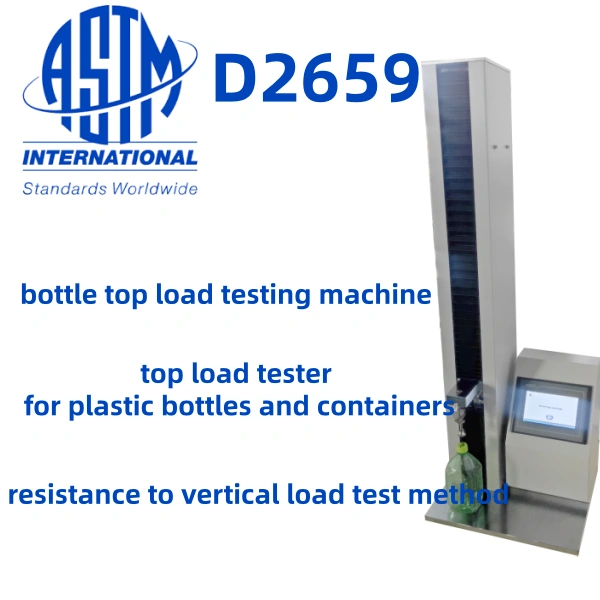
A professional בודק עומסים עליונים for plastic bottles and containers is designed to simulate real-world vertical compression conditions by applying controlled force to the top of a container until a specified deformation level or failure point is reached. By measuring compression force, displacement, and deformation behavior, engineers can evaluate container strength, optimize bottle design, reduce material consumption, and ensure consistent product quality.
ה- TLT-01 – מכשיר לבדיקת עומס עליון from Cell Instruments provides automated compression testing solutions for plastic bottles, drums, cartons, trays, and other packaging products. With precise force measurement, programmable test modes, and compliance with standards including ASTM D2659, ASTM D642, ASTM D4577, ASTM D4169, and ISO 8113, the system supports reliable quality control and packaging development across multiple industries.
What Is ASTM D2659 Testing?
ASTM D2659 is a standard test method developed for determining the מאפייני עמידות בפני ריסוק עמודי של מיכלים תרמופלסטיים מנופחים. It evaluates how much vertical compressive force a plastic container can withstand before reaching a defined deformation point or structural failure.
Plastic bottles and containers experience vertical loads throughout their lifecycle. During warehouse storage, containers may be stacked under continuous pressure. During transportation, vibration and impact can increase stress on packaging structures. A bottle with insufficient vertical strength may collapse, lose shape, or affect the integrity of the product inside.
The purpose of ASTM D2659 testing is to provide manufacturers with measurable data regarding:
- Maximum compressive strength
- Container deformation characteristics
- Buckling resistance
- Structural stability under vertical loads
- Material and design performance
Unlike simple visual inspection, ASTM D2659 testing provides quantitative mechanical data that engineers can use for packaging optimization and quality assurance.
Why Is Vertical Load Resistance Important for Plastic Containers?
Vertical load resistance directly affects packaging safety, production efficiency, and customer satisfaction. Modern packaging manufacturers continuously seek lighter and more sustainable designs, but reducing material thickness requires accurate mechanical evaluation.
A reliable resistance to vertical load test method helps determine whether a container design maintains sufficient strength after lightweighting.
Key benefits include:
Preventing Container Collapse During Transportation
Plastic bottles are commonly stacked in cartons, pallets, or storage areas. The weight from upper layers creates downward compression forces. If the container structure cannot support the load, deformation may occur and lead to:
- Bottle instability
- Product leakage
- Damaged labels
- Reduced shelf appearance
- Customer complaints
Vertical compression testing helps identify weak designs before products reach the market.
Improving Packaging Design Efficiency
Packaging engineers use compression test results to compare different:
- Bottle geometries
- Wall thicknesses
- Resin materials
- Manufacturing parameters
- Reinforcement structures
By analyzing force-displacement curves, engineers can optimize designs while reducing unnecessary material usage.
Supporting Quality Control Programs
Manufacturing variations such as uneven wall thickness, molding conditions, and material changes may affect container strength. Regular ASTM D2659 testing helps companies monitor production consistency and maintain reliable packaging performance.
How Does a Top Load Tester Work?
A bottle top load testing machine applies a controlled vertical compression force to the container through compression plates. During testing, the instrument continuously records the relationship between applied force and deformation.
The basic testing principle includes:
- Sample positioning
The plastic bottle or container is placed vertically between upper and lower compression platens. - Vertical load application
The tester moves the compression platen downward at a controlled speed, applying force to the container. - Force and displacement measurement
Sensors measure the compression force and deformation distance throughout the test. - Peak load determination
The system identifies the maximum load before structural failure or a specified deformation point. - Result evaluation
Engineers analyze the data to determine whether the container meets design requirements or applicable standards.
The TLT-01 Top Load Tester uses a precision ball-lead screw mechanism and PLC-controlled operation to provide stable movement and repeatable testing results.
ASTM D2659 Test Procedure Explained
Although specific laboratory procedures may vary depending on container design and company requirements, ASTM D2659 testing generally follows a controlled compression process.
Sample Preparation
Before testing, samples should be prepared under controlled conditions. Important factors include:
- Container type and dimensions
- Material specification
- Production batch information
- Environmental conditioning requirements
Consistent sample preparation improves repeatability and comparability between test results.
Positioning the Container
The container is placed upright between the compression plates. Proper alignment is critical because uneven positioning can create inaccurate stress distribution.
Applying Compression Load
The testing machine applies vertical force at a controlled speed. The system records load and displacement continuously throughout the compression process.
Recording Test Results
Typical measured parameters include:
| Parameter | Description |
|---|---|
| Maximum Load | Highest compression force achieved before failure or deformation |
| Deformation Distance | Vertical displacement during compression |
| Compression Curve | Relationship between force and deformation |
| Failure Mode | Type of structural collapse or buckling |
Evaluating Performance
Engineers compare results against internal specifications, customer requirements, or applicable standards to determine whether the container design provides sufficient mechanical protection.
Key Features of the TLT-01 Top Load Tester
ה- TLT-01 – מכשיר לבדיקת עומס עליון is designed for laboratories requiring accurate and efficient packaging compression evaluation.
Automated Testing Control
The instrument uses PLC control combined with a 7-inch HMI touchscreen interface. Operators can easily select test parameters, monitor testing status, and manage multiple testing programs.
Available test modes include:
- Peak Load Test
- Fixed Deformation Test
- Fixed Load Test
- Single Compression Test
- Cyclic Compression Test
These functions allow laboratories to simulate different packaging conditions.
High-Precision Measurement System
The tester provides:
- Test range up to 1000 N
- Force accuracy of 0.5% full scale
- Displacement accuracy of 0.01 mm
- Adjustable test speed from 1–500 mm/min
This level of precision supports both research applications and routine production quality control.
Flexible Sample Compatibility
The system supports various packaging structures, including:
- Plastic bottles
- Beverage containers
- Chemical containers
- Pharmaceutical containers
- Cartons
- Trays
- Boxes
The maximum sample height reaches 700 mm, with a maximum diameter of 120 mm.
Applications of ASTM D2659 Top Load Testing
ASTM D2659 testing is widely used across industries where container strength is critical.
Beverage Packaging
PET bottles for water, carbonated beverages, and functional drinks require sufficient vertical strength to withstand filling, transportation, and stacking.
Top load testing helps beverage manufacturers evaluate:
- Bottle lightweighting projects
- Preform and bottle design changes
- Production consistency
Pharmaceutical Packaging
Plastic containers used for pharmaceutical products must maintain structural integrity throughout distribution. Compression testing supports packaging validation and quality assurance.
Food Packaging
Food containers experience stacking pressure during storage and transportation. Vertical load testing helps confirm that packaging maintains shape and protection.
Chemical and Household Products
Detergent bottles, cleaning product containers, and industrial chemical packaging require strong resistance against deformation caused by storage loads.
Difference Between ASTM D2659 and Other Compression Standards
Several standards evaluate packaging compression performance, but each focuses on different applications.
| סטנדרטי | Main Application | Testing Focus |
|---|---|---|
| ASTM D2659 | Blown thermoplastic containers | Column crush properties |
| ASTM D642 | Shipping containers and unit loads | Compression resistance |
| ASTM D4577 | Containers under constant load | Long-term compression resistance |
| ASTM D4169 | Distribution systems | Packaging performance simulation |
| ISO 8113 | Glass containers | Resistance to vertical load |
ASTM D2659 specifically targets plastic container structural performance, making it especially relevant for bottle manufacturers and packaging developers.
Selecting the Right Top Load Tester for Plastic Bottles and Containers
When choosing a compression testing system, laboratories should consider several technical factors:
Force Capacity
The tester should provide sufficient load capacity for the container type being evaluated. Small beverage bottles and large industrial containers may require different force ranges.
Test Control Capability
Advanced systems should support different testing methods, including peak load, fixed deformation, and cyclic loading.
Measurement Accuracy
Reliable force and displacement measurement ensures meaningful comparison between samples.
Data Management
Modern laboratories benefit from systems offering:
- Digital result display
- Data export capability
- Printing options
- Integration with quality management systems
Custom Testing Solutions
Different packaging designs may require customized fixtures or testing configurations. Manufacturers with engineering capability can provide solutions for specialized applications.
Quality Control Benefits of ASTM D2659 Testing
For packaging manufacturers, mechanical testing is an essential part of maintaining product reliability. The ASTM D2659 test method provides objective performance data that supports continuous improvement throughout the packaging development and production process.
Supporting New Packaging Development
During the design stage, engineers need to balance container strength, weight reduction, production efficiency, and material cost. A plastic container that is too lightweight may fail under vertical compression, while excessive material increases production costs and environmental impact.
By using a top load tester for plastic bottles and containers, engineers can compare different designs and determine the optimal structure before large-scale production.
Typical development evaluations include:
- Different bottle shapes and geometries
- Various resin formulations
- Different wall thickness distributions
- Changes in molding conditions
- Reinforced structural designs
The test data allows engineers to make design decisions based on measurable mechanical performance rather than visual inspection alone.
Improving Manufacturing Consistency
Even when the container design remains unchanged, production variations can influence compression performance. Factors such as temperature control, molding pressure, material properties, and processing conditions may affect container strength.
Routine vertical compression testing helps manufacturers identify:
- Batch-to-batch strength variation
- Weak points in container structures
- Production process instability
- Material performance changes
By monitoring compression results over time, quality teams can establish acceptance criteria and improve manufacturing control.
Reducing Packaging Failure Risks
Packaging failures can create significant economic losses, including damaged products, transportation claims, and brand reputation issues.
ASTM D2659 testing helps companies reduce risks by identifying potential failures before products enter the supply chain.
Common failure modes detected through top load testing include:
- Side wall buckling
- Shoulder deformation
- Base collapse
- Permanent structural deformation
- Sudden container failure
Early detection enables manufacturers to adjust packaging designs and prevent costly field problems.
Technical Specifications of TLT-01 Top Load Tester
The TLT-01 is designed for laboratories requiring accurate and repeatable compression evaluation.
| Technical Parameter | Specification |
|---|---|
| טווח הבדיקה | 0–1000 N (customizable according to requirements) |
| גובה הדגימה | Maximum 700 mm |
| קוטר הדגימה | Maximum 120 mm |
| מהירות הבדיקה | 1–500 mm/min |
| דיוק המדידה | 0.01 mm |
| דיוק הכוח | ±0.5% Full Scale |
| Control System | PLC and HMI touchscreen |
| פלט נתונים | Screen display, optional microprinter, optional RS232 |
| Power Supply | 110–220 V, 50/60 Hz |
These specifications allow the instrument to perform accurate compression testing for a wide range of packaging products.
How to Interpret Top Load Test Results
Understanding test results is important for packaging engineers because compression data provides insight into structural behavior.
Maximum Compression Force
The maximum force represents the highest load the container can withstand before failure or significant deformation.
Higher values generally indicate stronger structural performance, but the required value depends on:
- Container application
- Distribution environment
- Product weight
- Storage conditions
Force-Deformation Curve
The force-displacement curve provides more information than a single peak value. Engineers can evaluate how the container behaves during loading.
Typical curve characteristics include:
- Initial elastic deformation
- Structural reinforcement stage
- Buckling point
- Collapse behavior
A stable curve often indicates predictable container performance, while sudden drops may indicate structural instability.
Deformation Characteristics
Two containers may have similar peak loads but different deformation behavior. Controlled deformation may be acceptable in some applications, while sudden collapse may indicate a design weakness.
ASTM D2659 Testing Equipment for Different Packaging Applications
A professional bottle top load testing machine should adapt to different container designs and industry requirements.
PET Bottle Testing
PET bottles are commonly evaluated for:
- Beverage applications
- Water packaging
- Carbonated drinks
- Personal care products
Testing helps manufacturers optimize bottle weight while maintaining transportation safety.
HDPE Container Testing
HDPE containers used in household chemicals and industrial products require excellent resistance against vertical loading.
Top load testing helps evaluate:
- Container rigidity
- Stack resistance
- Long-term durability
Pharmaceutical Plastic Containers
Pharmaceutical packaging requires consistent mechanical performance to protect sensitive products.
Compression testing supports:
- Packaging validation
- Supplier quality evaluation
- Regulatory documentation
Related Standards for Vertical Top Load Strength Testing
ASTM D2659 is one of several internationally recognized methods used for packaging compression evaluation.
ASTM D2659
Standard Test Method for Column Crush Properties of Blown Thermoplastic Containers
This standard evaluates the compression performance of blown plastic containers by measuring their resistance to vertical loading.
ASTM D642
Standard Test Method for Determining Compressive Resistance of Shipping Containers, Components, and Unit Loads
ASTM D642 focuses on shipping containers and evaluates their ability to withstand compression forces during distribution.
ASTM D4577
Standard Test Method for Compression Resistance of a Container Under Constant Load
This method evaluates container behavior under sustained compression conditions.
ASTM D4169
Standard Practice for Performance Testing of Shipping Containers and Systems
ASTM D4169 simulates distribution environments and evaluates packaging system performance.
ISO 8113
Glass Containers — Resistance to Vertical Load — Test Method
This standard evaluates vertical load resistance of glass containers and provides a comparable approach for rigid packaging evaluation.
Why Choose Cell Instruments for ASTM D2659 Testing Solutions?
Cell Instruments specializes in mechanical property testing equipment and provides professional solutions for packaging laboratories, manufacturers, research institutions, and quality inspection organizations.
Our expertise covers:
- Compression testing
- Tensile testing
- Seal strength testing
- Peel testing
- Tear testing
- Coefficient of friction testing
- Impact resistance testing
- Packaging performance evaluation
For ASTM D2659 applications, Cell Instruments provides:
Reliable Testing Performance
The TLT-01 Top Load Tester uses precise mechanical structures and advanced control technology to deliver stable and repeatable testing results.
Flexible Customization
Different packaging products may require different fixtures, testing methods, or automation functions. Customized solutions can be developed according to customer requirements.
Examples include:
- Special compression fixtures
- Multi-station testing systems
- Automated testing integration
- Customized software functions
Global Technical Support
Cell Instruments supports customers worldwide with:
- Application consultation
- Testing method guidance
- Equipment selection assistance
- Customized testing solutions
This ensures laboratories can select the most suitable testing configuration for their packaging requirements.
Frequently Asked Questions About ASTM D2659 Top Load Testing
1. What does ASTM D2659 measure?
ASTM D2659 measures the column crush properties of blown thermoplastic containers by evaluating their resistance to vertical compression forces.
2. Why is top load testing important for plastic bottles?
Top load testing determines whether bottles can withstand stacking, transportation, and storage stresses without excessive deformation or collapse.
3. What equipment is used for ASTM D2659 testing?
A specialized compression testing instrument, such as the TLT-01 Top Load Tester, is used to apply controlled vertical force and measure container strength.
4. Can one tester evaluate different packaging products?
Yes. With suitable fixtures and adjustable test parameters, a top load tester can evaluate bottles, containers, cartons, trays, and other packaging structures.
5. How does ASTM D2659 help reduce packaging costs?
By providing accurate strength data, ASTM D2659 allows engineers to optimize material usage and develop lightweight packaging without sacrificing performance.
Final Thoughts
Reliable vertical load testing helps manufacturers create stronger, lighter, and more cost-effective packaging solutions. Cell Instruments provides professional top load testing equipment designed for ASTM D2659 and other packaging compression evaluation requirements. With accurate measurement systems, customizable fixtures, and technical support, our solutions help laboratories improve quality control and optimize packaging performance. Contact מכשירים לתאים to explore suitable testing equipment and customized solutions for your packaging applications.